| Marke | Rizzardi |
| Modell | INfive |
| Typ łodzi | Inne |
| Kategoria | Jacht motorowy |
| Silniki | 2 |
| Moc | 850 PS |
| Paliwo | Benzin |
| Rok produkcji | 2026 |
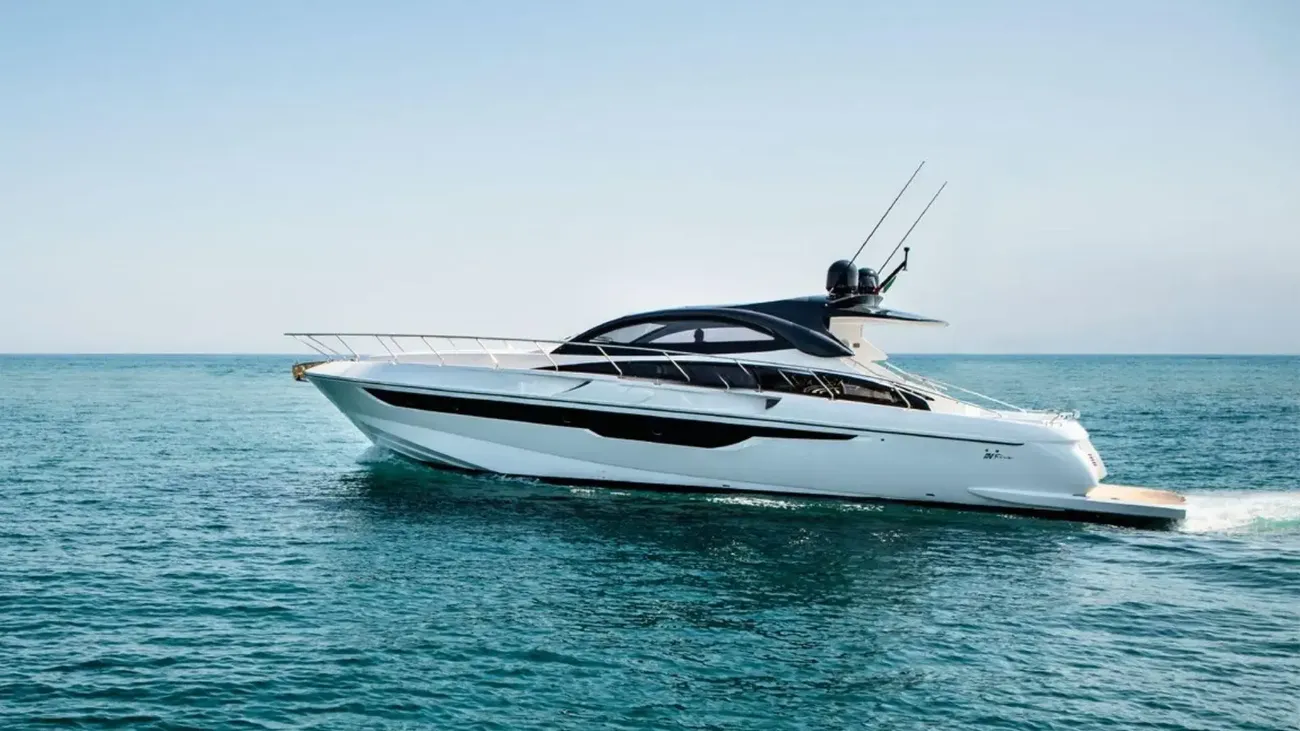
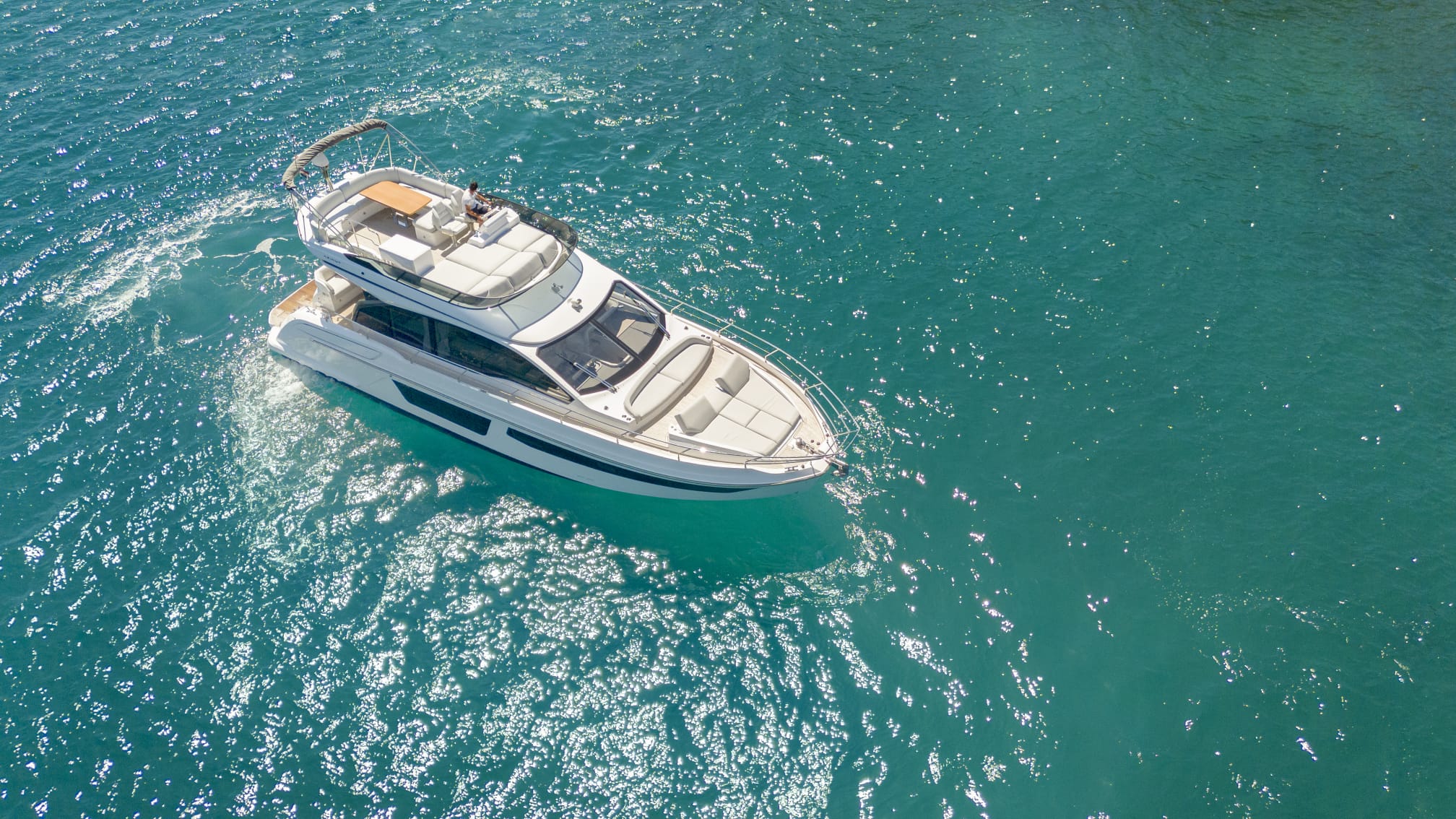
The new INfive is a standout in its category.
It boasts a top speed of 45 knots.
With 95 different customization options, it offers versatility.
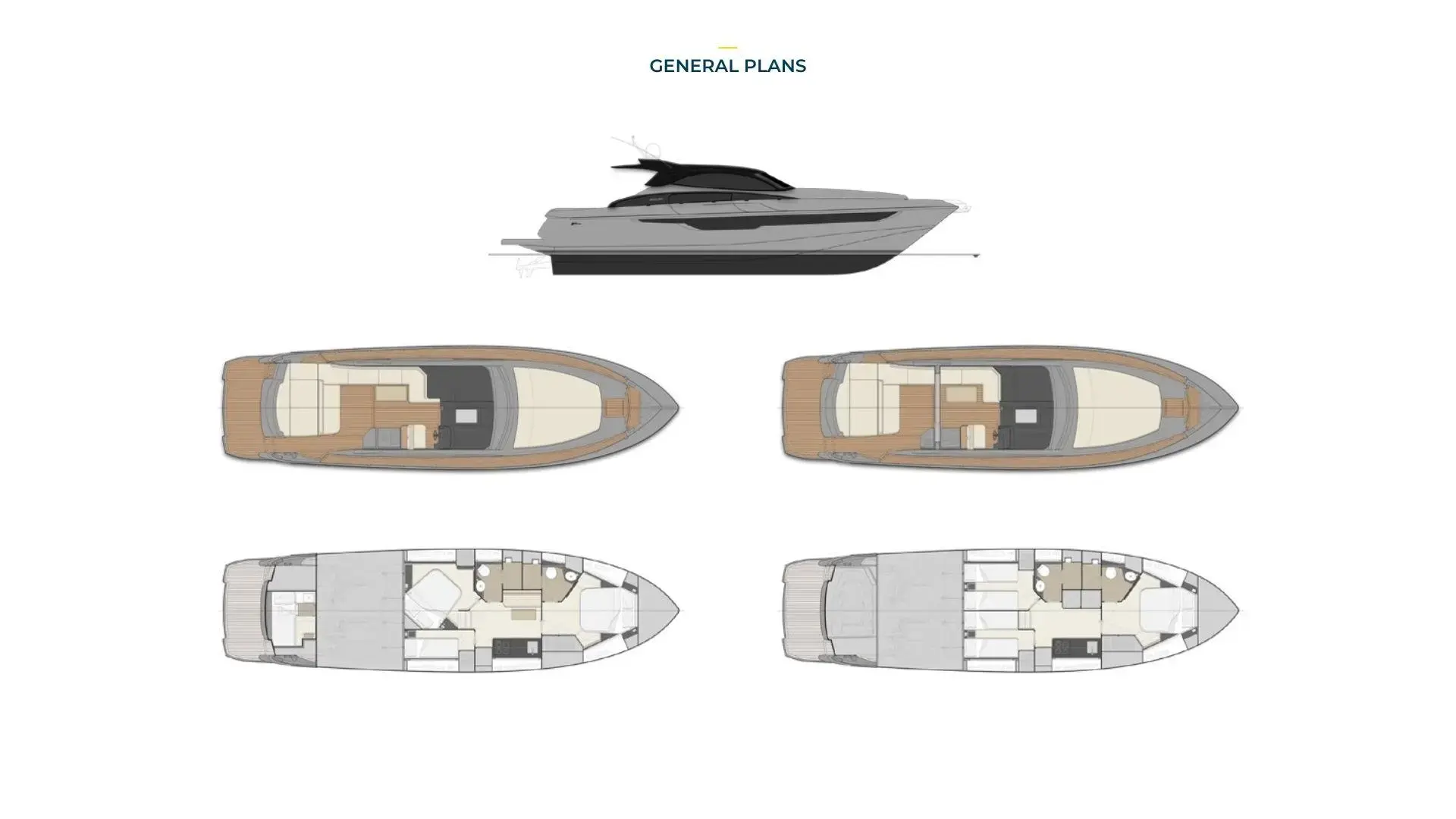
It features 3 cabins plus a crew cabin or garage within 16 meters.
This is for those who seek to break the mold.
The boat is constructed in three parts: hull, deck, and superstructure.
It is built using GRP. The initial layers of the hull lamination utilize fiberglass (type E) impregnated with vinyl-ester resin for high osmosis prevention.
Isophthalic polyester resin, approved by major Classification Registers, is used for the lamination of the remaining parts.
The hull structure features a combination of longitudinal and transverse stringers for the bottom and a PVC core sandwich for the sides.
Sandwich construction is employed for both the deck and the superstructure.
All structural bulkheads are made with PVC core sandwich or marine plywood approved by the Italian Naval Register. The hull bottom has a deep V with a 15° DEADRISE at the stern.
Engines:
Surface Propulsion Systems: Top System TS65
Propellers: Alloy, 5 blades, progressive pitch.
Main characteristics
The electrical system complies with current legislation. The rated voltages on board are:
All main system lines connect to the main electrical panel, protected by magneto-thermal switches.
The electric cables are “not propagating the flame and reduced emission of smoke and toxic gases”. FROR cables are used for the 220 V AC section and double isolated cables for the 24 V DC section. The cross-section of cables is properly sized for the maximum allowed current load.
The electric cables are assembled in self-extinguishing closed PVC.
The ground system consists of a dedicated line collecting the grounds of the water inlets, supports, and all 24 V equipment, connected to a zinc anode fitted on the transom.
The engines and electronic control units have a separate ground system connected to a second zinc anode fitted on the transom.
The electrical generator, electrical panel, and all 220 V AC utilities connect to a porous plate.
Integrated monitoring and control system
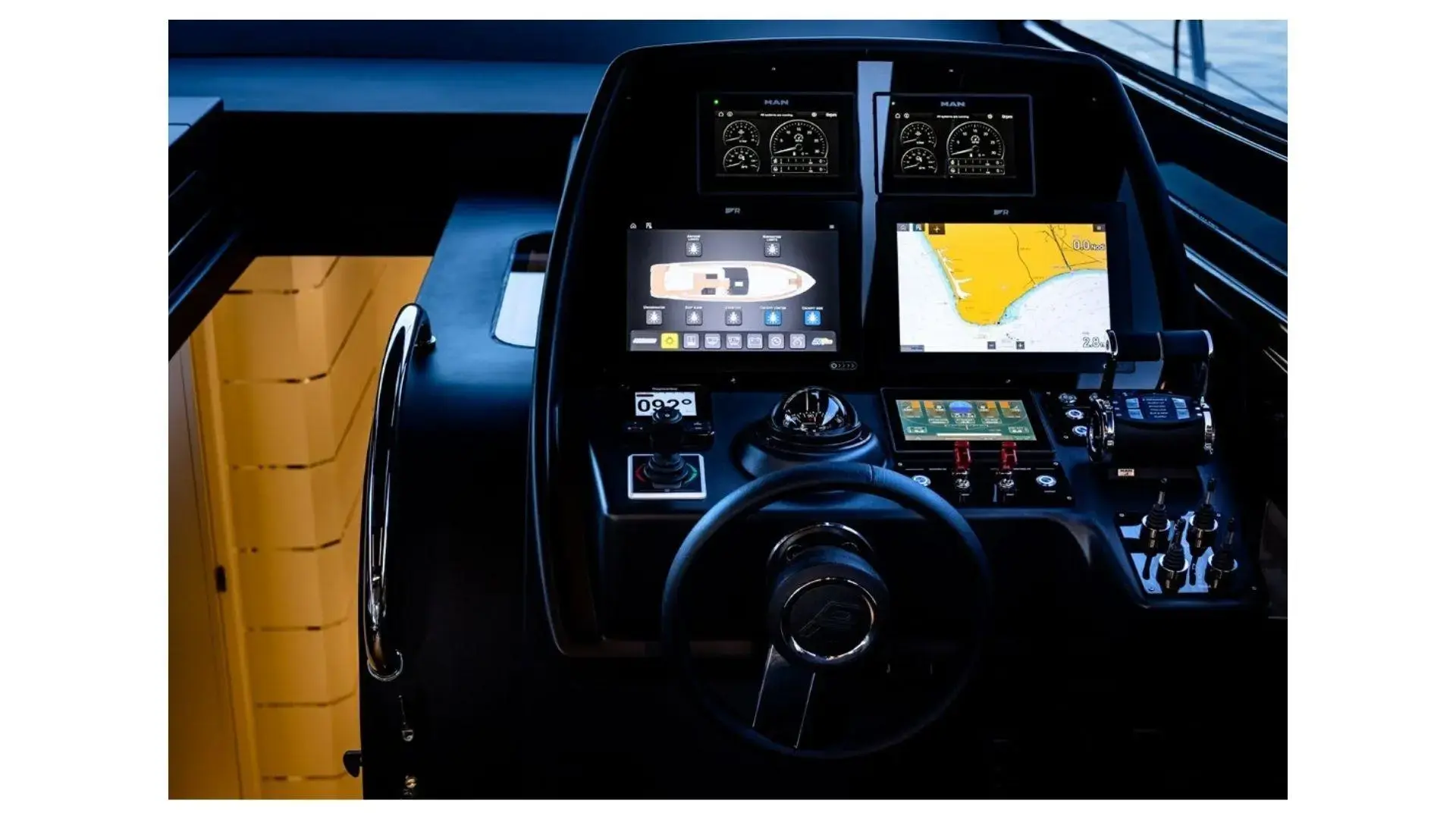
A section of the system is controlled through an integrated monitoring and control system, operated via touch screens on the dashboard. All utilities are protected by virtual magneto-thermal and fuses. Manual control can be operated in case of emergency.
AC power sources
Control panel and hour-meter, entertainment, and cabin sockets.
DC power sources
Operated electrically. The system allows parallel connection between engine start batteries and service batteries.
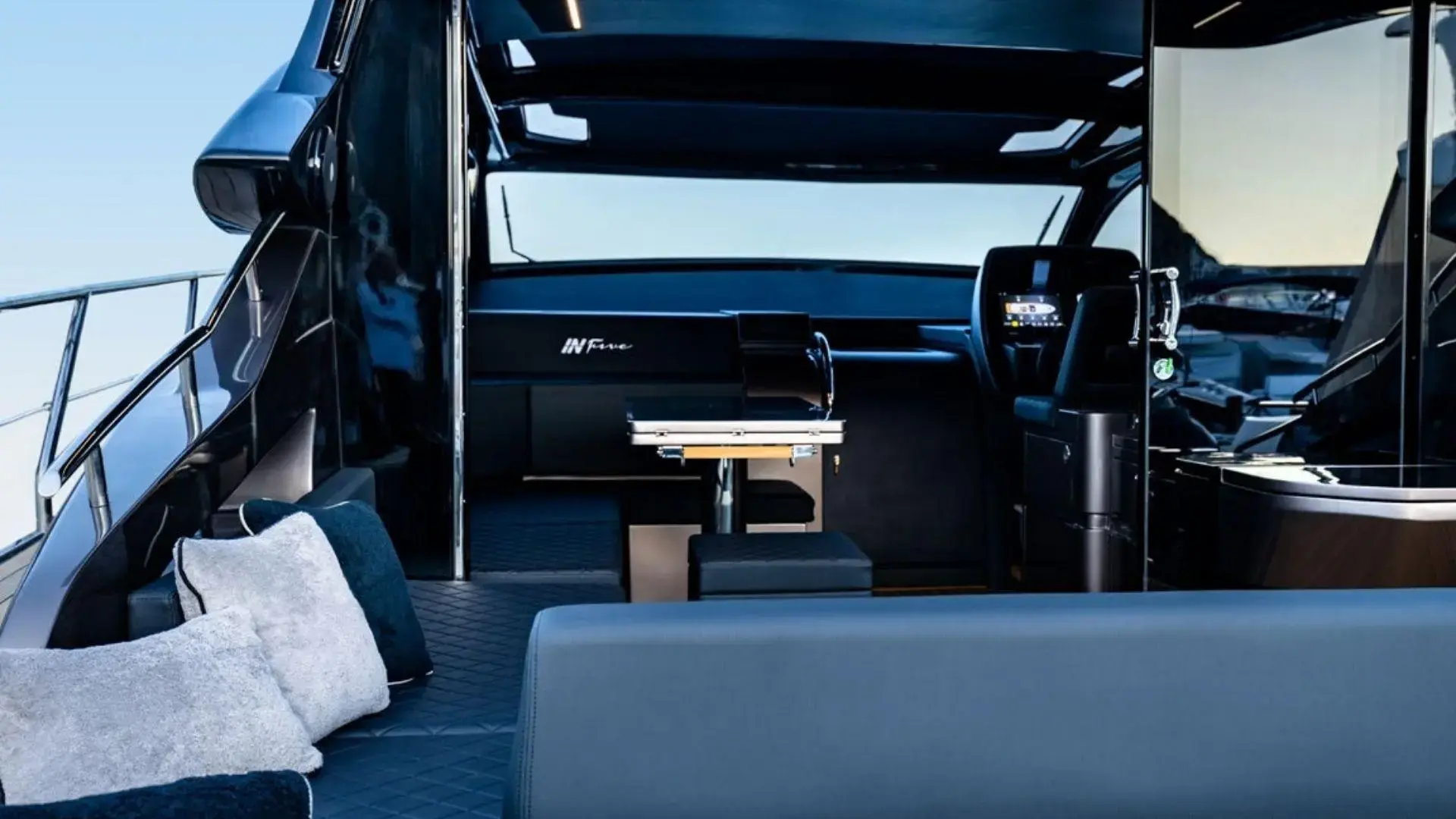
Dashboard and Roll Bar
Audio/video system
The integrated audio system includes a main unit controlling dinette and cockpit, with volume adjustment possible in each area. There are No. 2 speakers in the dinette and No. 2 speakers in the cockpit.
The video system includes a digital terrestrial antenna, a TV in the owner’s cabin, and predisposition for a TV in the cockpit.
Note: Electronics and entertainment systems may vary depending on market evolution.
BILGE PUMP SYSTEM
The bilge system allows pumping from each watertight compartment using at least 2 separate systems. The main suction of the bilges and outboard discharge is performed through submersible electric pumps activated by water level sensors. Manual activation is allowed from the dashboard and main electrical panel; an electric pump is installed for each watertight compartment.
The centralized bilge pump system has a suction box in each watertight compartment, with selection made through the collector located in the engine room.
The bilge alarm system provides, for each compartment, a lower sensor that automatically activates the submersible pump and a second sensor placed higher for a bilge alarm on the dashboard display.
An emergency system is also provided in the engine room by suction from the engine cooling circuit.
FIRE FIGHTING AND SAFETY SYSTEM
A manual/automatic system is installed for engine room protection. Manual activation is done through a handle located in the cockpit. A temperature sensor in the engine room automatically activates the system. When discharged, a loud and visual alarm is activated. Fire is detected by smoke and temperature detectors, with the alarm displayed at the helm station. The boat is equipped with portable powder extinguishers located according to Safety Regulations.
FUEL SYSTEM
The fuel system consists of alloy tanks with a total capacity of 2000 liters; the system includes electric and optic level gauges. Deck fuel fillers are located on each side. All hoses are certified for fuel use.
FRESH WATER SYSTEM
Fresh water is supplied by a 550 liters structural tank located in the lower deck. A 24V water pressure pump is located in the engine room. An electric water heater delivers hot water to the system. A shore water connection (OPT) allows fresh water supply to the system.
BLACK AND GRAY WATER SYSTEM
Waste waters from showers, washbasins, and galley are collected in a structural gray water tank with level sensor and emptying pump. The WC flushing system uses sea water. Waste waters are collected in a black water holding tank or discharged directly.
SEA WATER SYSTEM
Main sea water inlets are in the engine room bilge. Each inlet is fitted with a valve and stainless-steel filter; sea water is supplied to the main circuits on board, including engine cooling systems, generator, and air conditioning. The cooling system of each engine also cools the reversing gear and the risers of the engine exhaust system.
MAIN ENGINES EXHAUST SYSTEM
The exhaust pipes of the main engines are made with AISI 316L Stainless steel and sized according to the engine manufacturer’s directions. The main exhaust pipe connects to a properly sized muffler, which is connected to the stern of the boat, under the swimming platform, through a GRP rigid pipe. The engine exhaust pipes are insulated with ceramic therm-insulating material.
AIR CONDITIONING SYSTEM (OPT)
The air conditioning system has a 24,000 BTU cooling capacity and consists of a cooling unit, treated water and sea water circulation pumps located in the engine room. Fan coils, with automatic and independent control and regulation, are positioned in each cabin and in the dinette. The system can function as a heat pump.
HYDRAULIC SYSTEMS
Steering system: the steering system, integrated with the transmission, is power-assisted through a high-pressure pump installed on the PTO of the main engine. Steering is controlled through a pump connected behind the steering wheel.
Trim and Flaps: a single hydraulic control unit allows adjustment of the surface propellers immersion (up - down) and of the flaps for dynamic trim of the boat.
The gangway is managed with a single hydraulic control unit. A second hydraulic control unit provides for the access door opening to the engine room and the movement of the Hard top.
All control units are located in the engine room.
VENTILATION AND EXHAUST BLOWERS
The engine room ventilation is sized as required by the engine and generator manufacturers.
The forward engine room bulkhead is insulated with sound-absorbing and sound-insulating materials. Hull sides are insulated with multi-layer quilt or similar material.
The safety equipment complies with current rules and regulations: user manual, lifebuoy with light and floating line, rigid inflatable life-raft, lifejackets, life-rafts with line, flares, smoke-signal kit, first aid box, binoculars, fire-resistant blanket, portable horn, No. 3 mooring lines, boat hooks, No. 8 cylindrical fenders, weather station, Italian flag, radar reflector.
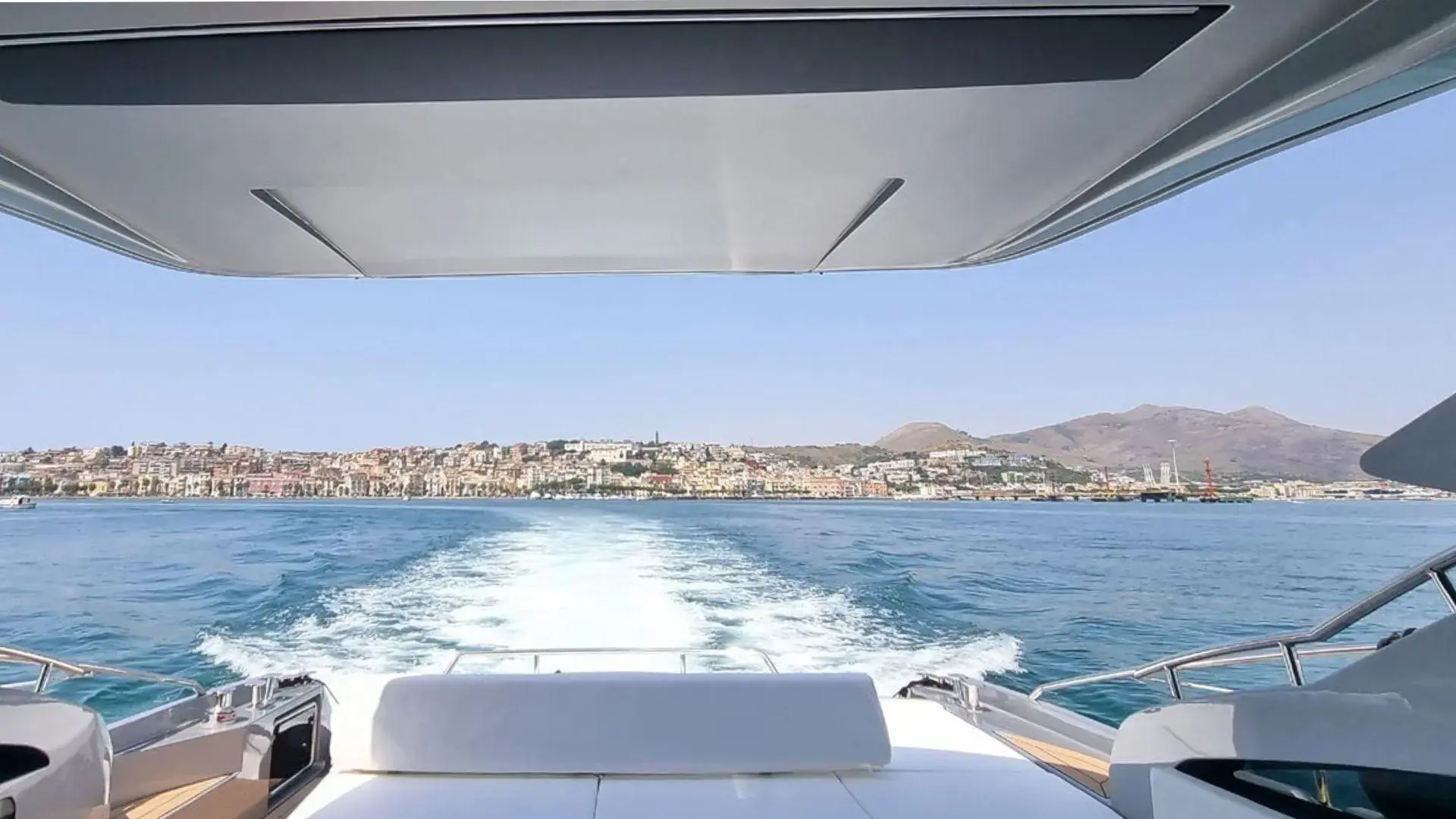
Cockpit and Swimming platform
Teak floor, 220V shore power connection, hydraulic gangway, manual swimming ladder, small shower with mixer, storage locker for life-rafts, nr. 2 cleats and fairleads, safety cockpit gate, sunbathing cushions, opening cockpit table, fridge, GRP furniture with cooking plate and sink, dashboard, main and courtesy lights, engine room hatch, Rizzardi logo, deck fillers, stainless steel handrail.
Forward mooring/sunbathing area
Fore peak, chain locker with notch chain list, stainless steel bow roller, 30kg anchor, 75m (10mm diameter) galvanized chain, nr. 2 cleats, nr. 2 fairleads, 1500W 24V anchor windlass, shower head with mixer, sunbathing cushions, stainless steel handrail.
Superstructure
Navigation lights, flagstaff mast with anchor light, GPS and VHF antennas, searchlight and horn, wind shield wipers, sliding opening roof panel with electric control, transparent laminated glass wind shield, gray monolithic sides glass.
All areas are complete with carpet (unless otherwise specified), venetian blinds, main and courtesy lights.
STANDARD VERSION
Dinette / galley
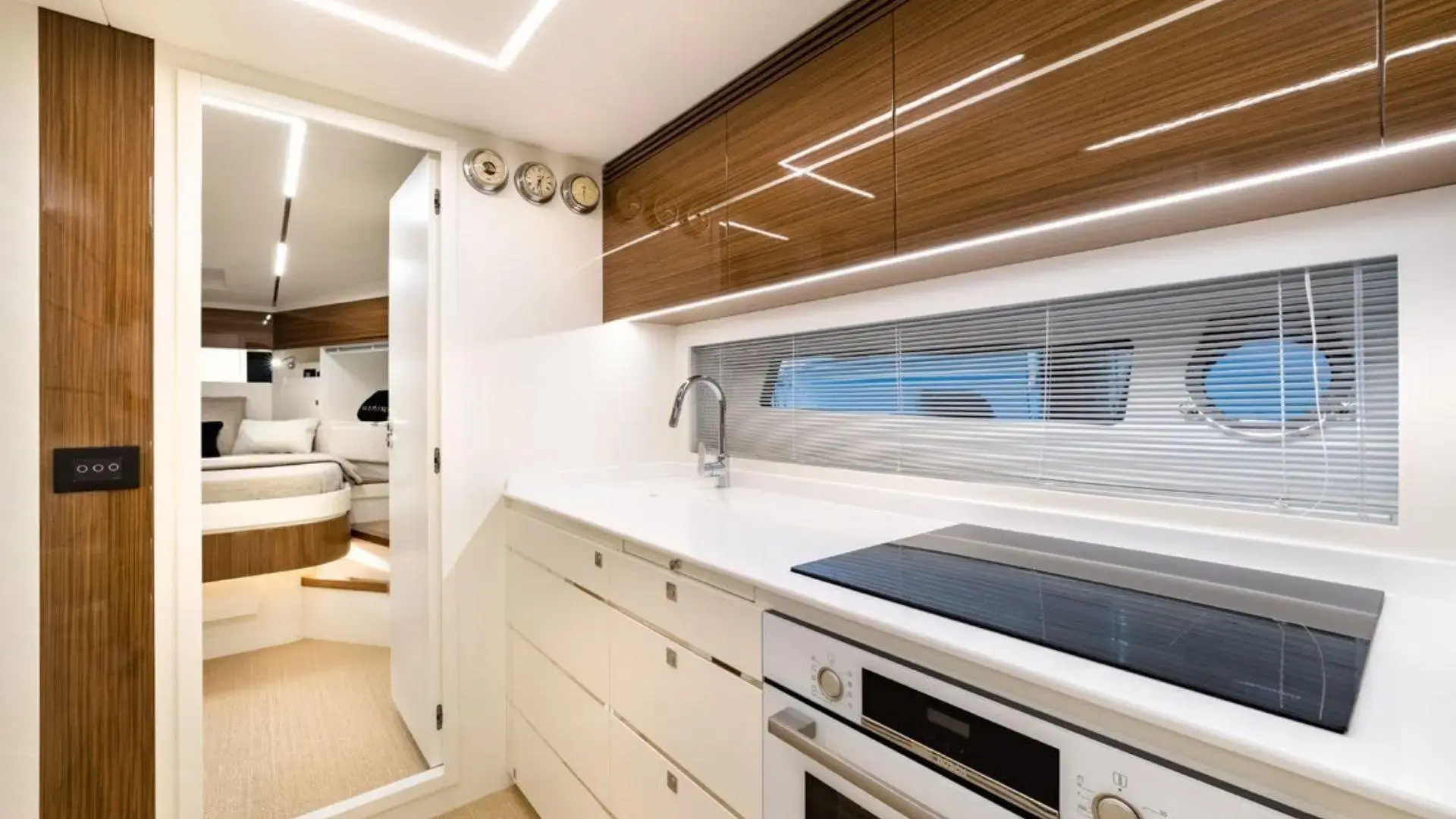
Sofa with storage, electric panel cabinet, kitchen furniture complete with top in acrylic stone, electric hob with four burners, microwave oven (OPT), fridge, stainless steel sink with water mixer and faucet, porthole.
Owner’s cabin
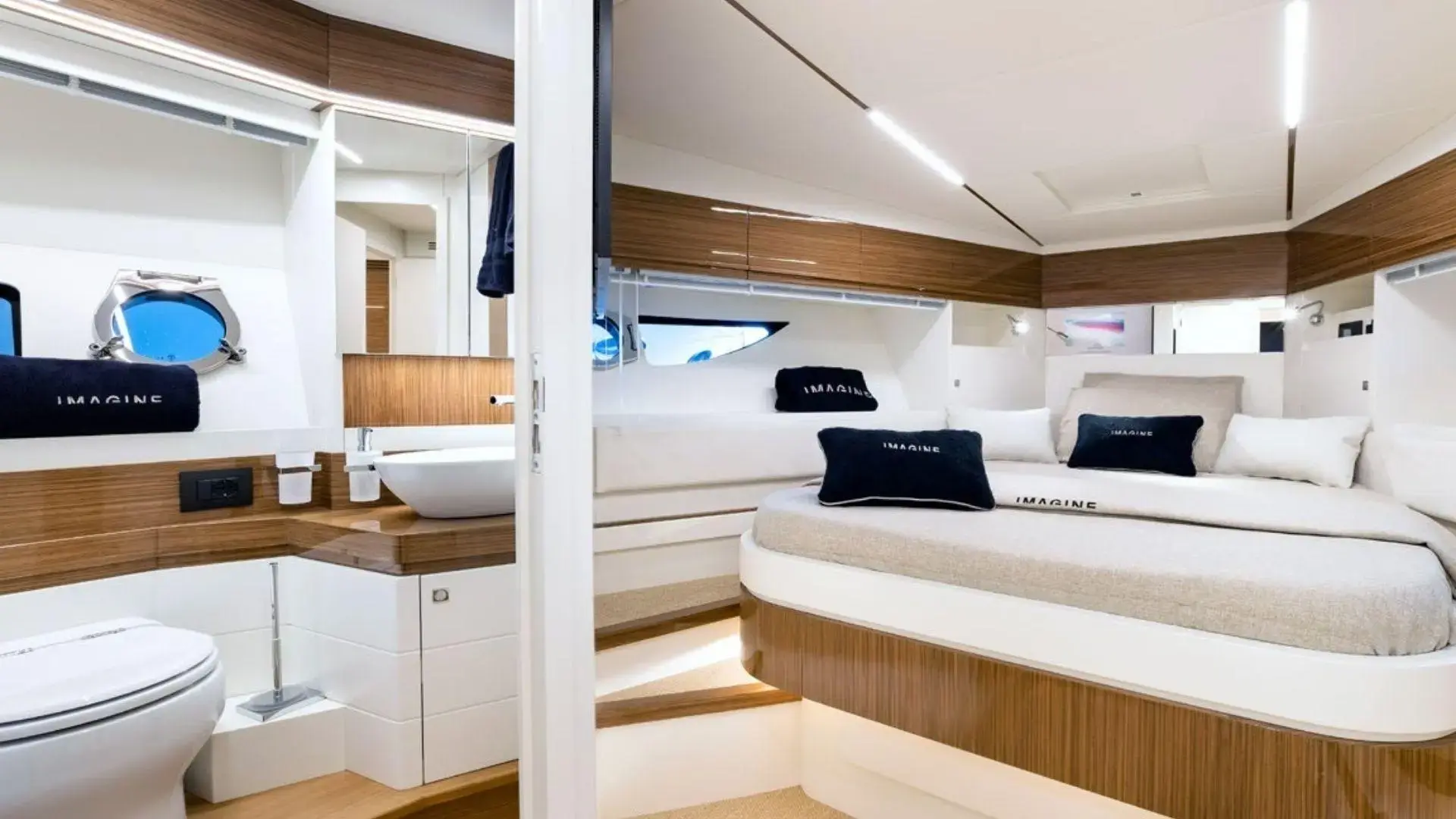
Matrimonial bed with mattress and bed cover, drawers under the bed, bedside tabletops, overhead cabinets, wardrobe, safe, Nr. 2 portholes.
Owner’s bathroom
Furniture with sink and mixer, teak floor, toilet paper roll holder / toilet brush holder / towel holder / soap dispenser / toothbrush holder, mirror, electric WC with integrated bidet.
Box shower with glass door, mixer and shower head, teak grating, porthole.
Port guest cabin
Two single beds with mattress and bed cover, bedside tabletop, wardrobe, porthole.
Starboard guest cabin
Twin beds with mattress and bed cover, bedside tabletop, wardrobe, porthole.
Guest bathrooms
Furniture with sink and mixer, teak floor, toilet paper roll holder / toilet brush holder / towel holder, mirror, electric WC.
Box shower with glass door, mixer and small shower, teak grating, porthole.
VIP VERSION
Refer to the STD version, unless otherwise specified.
Port VIP cabin
Matrimonial bed with mattress and bed cover, bedside tabletop, wardrobe, porthole.
Starboard guest cabin
Single bed with mattress and bed cover, bedside tabletop, wardrobe, porthole.
Note: tapestries and wood veneer are to be agreed and evaluated with the shipyard staff.
1.790.000,00 €
1.750.000,00 €
1.750.000,00 €
1.699.000,00 €
1.600.000,00 €
1.600.000,00 €
1.599.000,00 €
1.595.000,00 €
1.469.000,00 €
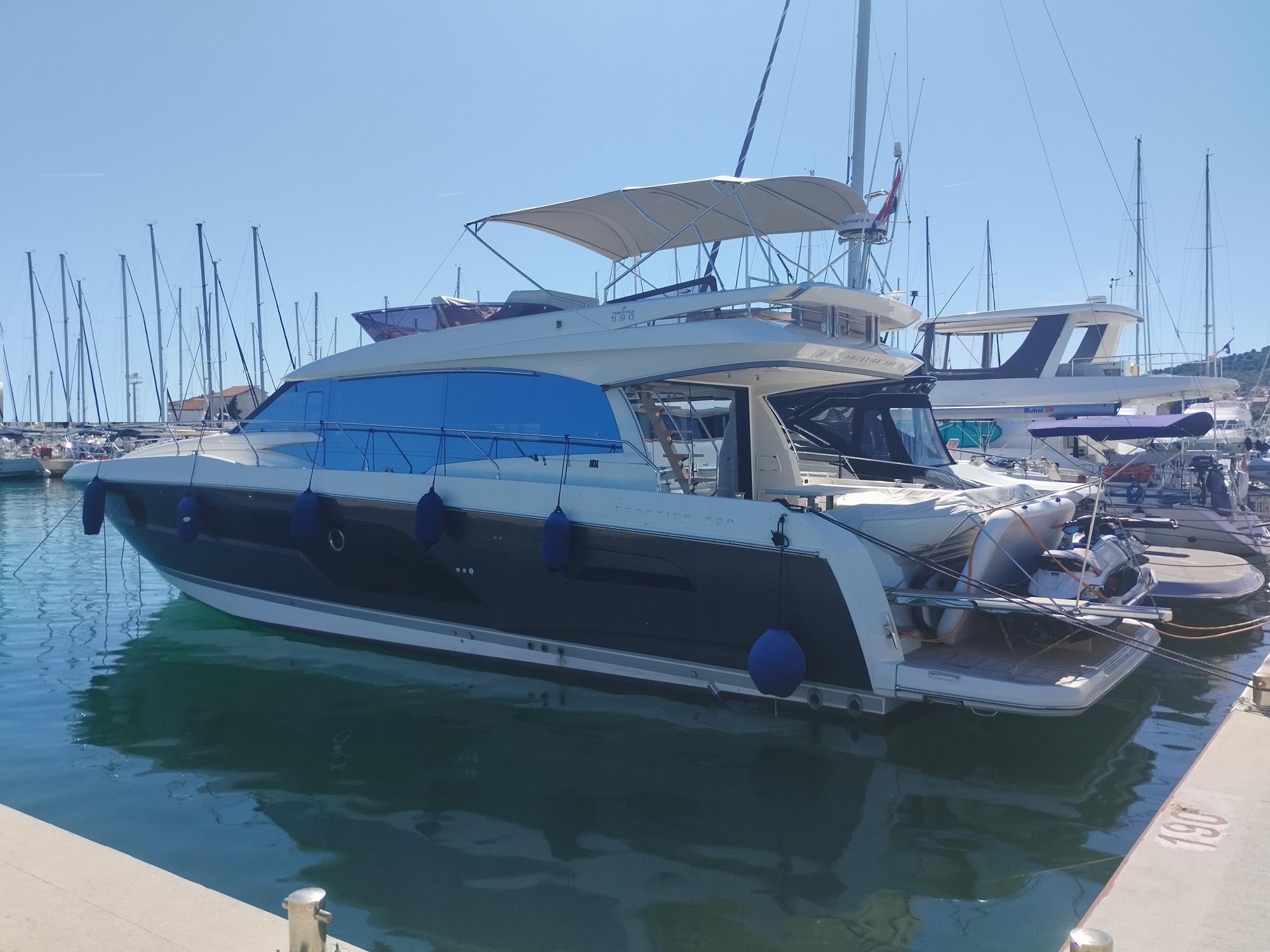
1.390.000,00 €
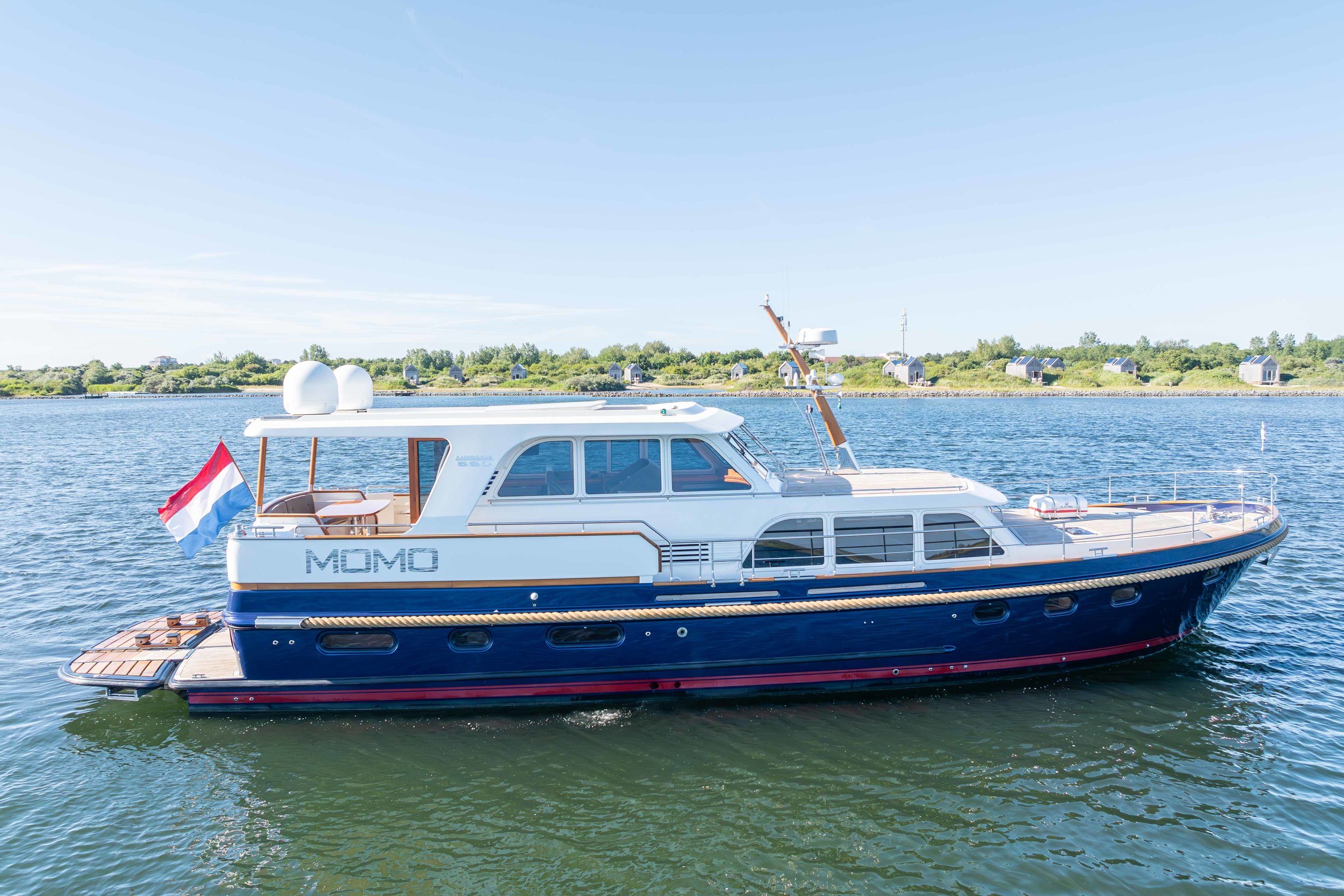
1.375.000,00 €
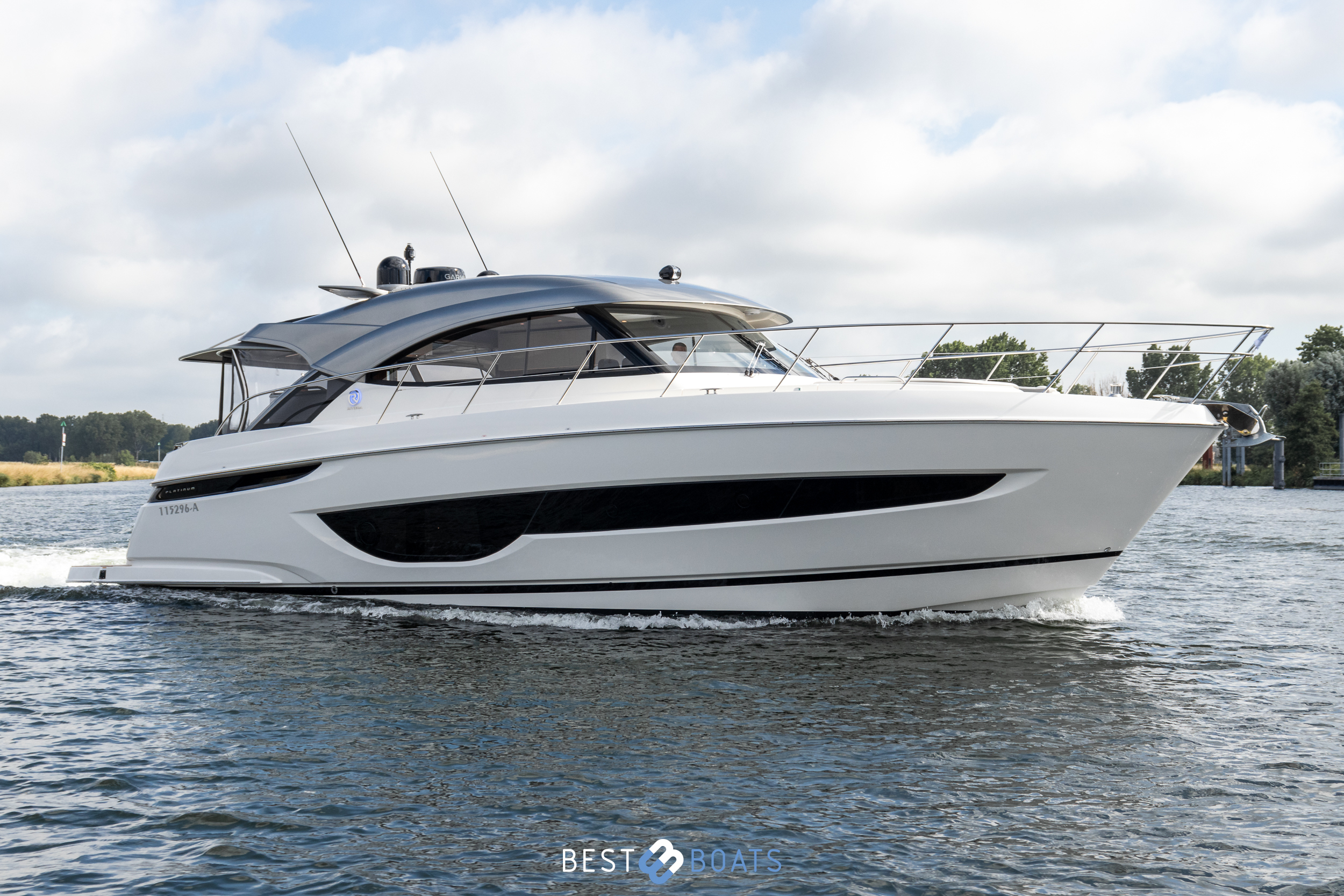
1.350.000,00 €
2.290.000,00 €
1.290.000,00 €
2.300.000,00 €
 Nowy
Nowy
1.723.394,23 €
 Nowy
Nowy
814.304,18 €
 Nowy
Nowy
116.329,17 €
 Nowy
Nowy
857.389,06 €
 Nowy
Nowy
2.408.444,64 €
 Nowy
Nowy
1.162.429,99 €
 Nowy
Nowy
1.895.734,60 €
 Nowy
Nowy
171.477,81 €
 Nowy
Nowy
904.782,42 €
 Nowy
Nowy
409.306,33 €
 Nowy
Nowy
162.860,84 €
 Nowy
Nowy
473.071,95 €
 Nowy
Nowy
228.349,85 €
 Nowy
Nowy
790.000,00 €
 Nowy
Nowy
285.000,00 €
 Nowy
Nowy
485.000,00 €
 Nowy
Nowy
529.000,00 €
 Nowy
Nowy
510.000,00 €
 Nowy
Nowy
235.000,00 €
 Nowy
Nowy
450.000,00 €